
The Split Second That Could Have Erased Everything
A stroke survivor's lesson on why "Don't Get Injured" is the fifth law of recovery

Recovery and growth live at the edge, in the narrow space between comfort, challenge, and catastrophe. One careless push beyond that edge can erase months of progress. This is how I almost learned that lesson the hard way.
"Lost in this utopic world, I grabbed the rail, pushed myself an inch above the commode chair, and bent just slightly forward to clean my underside. Then I reached for the soaped cloth and slipped." (Beyond 100%, my upcoming book)
Time stood still.
"In that heart-stopping moment between slip and fall, time slowed. My mind sprinted ahead with terrible clarity: The nurse reaching to catch me, my body crashing against the hard tile and wet floor. The crash, the sharp pain. The doctors shaking their heads, the X-rays, the new injuries, the additional days or weeks of recovery. The absurd stupidity of it all. All my progress erased because of one careless moment." (Beyond 100%)
In that split second, I saw my entire recovery journey flash before my eyes, almost wiped out by a moment of arrogance in a hospital shower.
"My heart kept racing as I fell back onto the secure commode instead of tumbling to the floor." (Beyond 100%)
I didn't fall. But I came close enough to understand what was at stake.
The Best Shower That Almost Became the Worst Setback
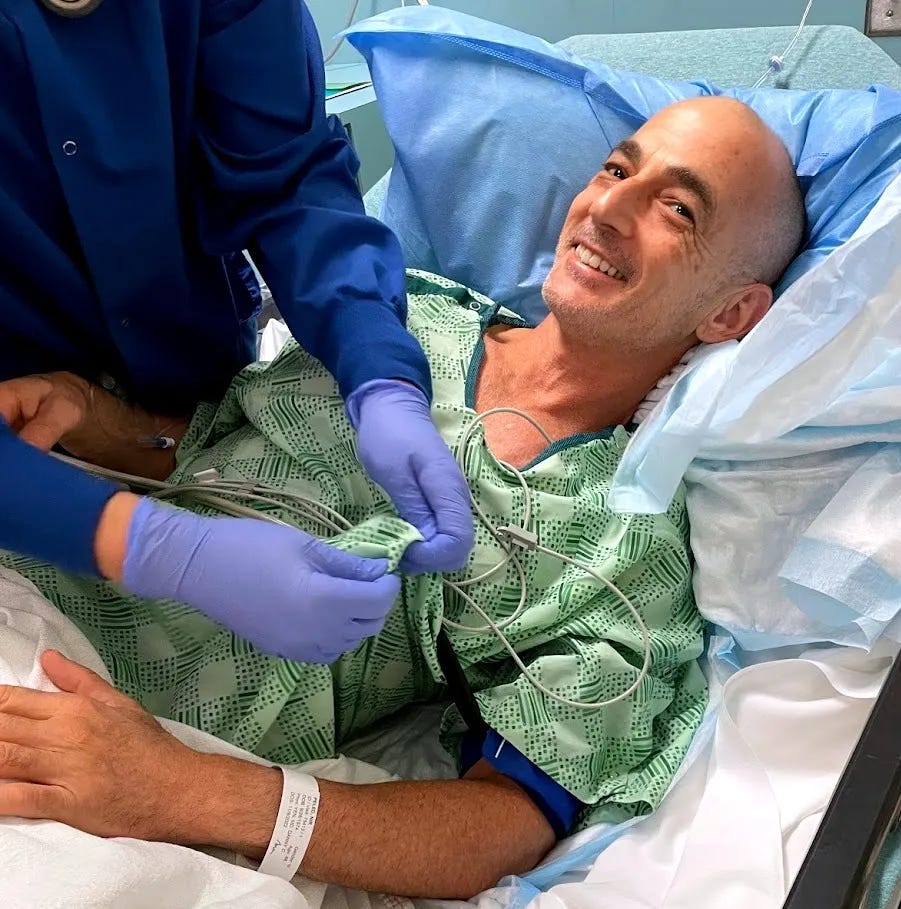
Let me set the scene. Just hours earlier, I'd been celebrating a milestone. I was transitioning out of the ICU to a regular hospital unit, a sign that I survived and was stable enough to begin the next phase of recovery.
"It immediately struck me how much quieter it was than the ICU. Nothing seemed urgent here. I remained connected to my PICC line 'just in case,' but everything else had been removed. The room offered more space for visitors, a door to the bathroom with a shower, and the most important thing: a window to the outside world." (Beyond 100%)
For the first time in ten days, I could see sunlight. I felt human again.
"When the new nurse arrived to perform their usual checks, he also mentioned 'showering,' so casually that I asked him to repeat. He confirmed what I thought I'd heard: he could help me shower if I wanted to. Oh, how I wanted to!"
"It was one of the best showers of my life."
"Layers of stickiness peeled off my skin, the hospital grime washing away as warm water ran over my body, dripping from my head to my face and shoulders. It was a sensory symphony, the muffled sound when water covered my ears, the fresh smell of water and soap combining to an almost hypnotic effect. It felt like a spa treatment, right there in a commode chair in a hospital shower." (Beyond 100%)
The simple pleasure of that shower made me forget everything. That I was still in the hospital, and how fragile my recovery still was. How much I had to lose. For those blissful moments, I wasn't a stroke patient. I was just a man enjoying hot water and soap.
Then, I slipped.
The Rule That Saved Me From Myself
"This moment crystallized what would become my fifth recovery principle: the 'Don't Get Injured' Rule." (Beyond 100%)
The irony wasn't lost on me. I was in the hospital because my brain had already betrayed me once. Now I was literally adding insult to injury, through my own carelessness.
"Back in Portland, Niv and I both had dirt bikes. Our motto was to have fun but make sure we'd “wake up in our own beds tomorrow”. Meaning, don't get injured. Here, the 'Don't Get Injured' Rule became non-negotiable. One bad fall wouldn't just ruin a weekend; it could erase weeks or months of painstaking progress. The fastest way to go backward is to try pushing forward too hard."
This wasn't just about physical safety. It was about protecting the momentum I'd built, the trust I was rebuilding in my body, the hope that kept me going through the hardest days.
"Every action, every decision had to pass this test: Is this worth the risk of undoing everything I've worked for? Usually, the answer was no. I couldn't bear the thought of explaining to my doctors, my wife, my daughter, or myself, how I'd sabotaged my recovery through some avoidable, foolish risk." (Beyond 100%)
The shower incident taught me that recovery is equal parts effort and restraint.
How "Don't Get Injured" Enables Progress
This wasn't about becoming overly cautious or paralyzed by fear. The "Don't Get Injured" rule actually empowered me to push harder when it mattered. I was learning to choose my battles wisely.
Three months later, I created and faced my biggest physical challenge yet: a five-mile walk, far enough to prove something to myself. This is where the rule proved its real value.
"That morning, I prepared meticulously, extra water in my fanny pack, hat, sunscreen, and notably, no cane. I had abandoned it the previous week after realizing it had become unnecessary and potentially problematic."
"Before I set out, I stood at my starting point, activated my tracking app, and repeated a mental mantra: the most important goal today is to not injure myself. I knew my personality. Once I began and my heart rate increased, adrenaline and excitement would build alongside the sweat and heavy breathing, and maintaining this safety awareness would become challenging. I needed to implant this priority into my mind so that it would remain accessible even when my cognitive resources were primarily devoted to physical exertion." (Beyond 100%)
The difference was clear: the shower incident was careless overconfidence. The five-mile walk was calculated risk-taking, backed by preparation and constant awareness.
"Midway through the walk, my prediction proved accurate. Breathing hard, sweating profusely, walking faster than usual, I checked my heart rate to see that it was over 140 beats per minute. I had entered that mental zone where oxygen prioritization limited me to perhaps one conscious thought. That thought became my mantra: don't fall, don't fall, don't fall."
"I repeated it with each step, maintaining caution in foot placement, ensuring I lifted my right leg with intention rather than dragging it. At my current speed, a single dragging step could send me face-first onto the pavement. I even scanned for patches of grass along my route, preferred landing zones should I stumble in spite of my precautions." (Beyond 100%)
This is what the "Don't Get Injured" rule enables: the ability to work at your edge safely. To push yourself without pushing past the point of no return. It's the difference between reckless and impatient choices and brave and smart ones.
The Hardest Part Isn't Physical
"I returned home triumphant and drenched in sweat. My wife was there with the location-tracking app open on her phone, waiting anxiously by the door."
"'Five miles?' she asked, eyebrows raised. 'That seems a bit ambitious for your first big challenge.'"
"'Had to be done,' I replied between deep breaths. 'The hardest part wasn't the walking.'"
"'What was it then?'"
"'Remembering not to fall when all I really wanted was to go faster.'" (Beyond 100%)
That's the truth about recovery that no one tells you. The hardest part isn't the physical challenge; it's the mental discipline to stay within your limits when every instinct tells you to push harder. It's choosing small, steady gains over risky leaps. It's being both the eager child learning to ride his bike and the watchful parent making sure they wear protective gear.
Four Tools for When You Want to Go Faster
The "Don't Get Injured" rule applies far beyond stroke recovery; it's for anyone growing, recovering, or pushing their limits. Progress requires being at the edge of your limits, yet while there, you must protect your gains and carefully expand your boundaries.
The slip in the shower wasn't my last "almost" incident; despite constantly reminding myself of this rule, my enthusiasm, competitive nature and frustration made it hard to follow. But I did my best, and still do. And here's what helps:
The Judgment Call: "If there is a doubt, there is no doubt!" (Military wisdom that saved me repeatedly). When your gut says, "Maybe this isn't wise," listen.
Make It a Mantra: Before any challenging situation, say it out loud: "The most important goal today is to not get injured." This isn't about being afraid; it's about being smart. Just like Niv and I did before riding off on our dirt bikes.
Think Parent and Child: Ask yourself: “What would I tell my child in this situation?” Then follow that advice. In recovery, YOU are the child, relearning new things, but without a grown-up to guide you. Be that grown-up.
Embrace 1% Improvement: If you take only ONE thing from this story, let it be this: Give yourself a break. 1% is more than enough. I know it doesn't feel like enough. Small improvements prevent disasters and eventually add up to something remarkable.
What's your version of the shower moment? Where in your life are you one careless decision away from undoing hard-won progress?
The "Don't Get Injured" rule is about respecting the process enough to protect it. It's about understanding that the fastest way forward sometimes means choosing NOT to go as fast as you would like. Keep growing, keep pushing, but protect your hopes and your progress!