
When Surrender Became My Strength
The time when giving in meant the opposite of giving up

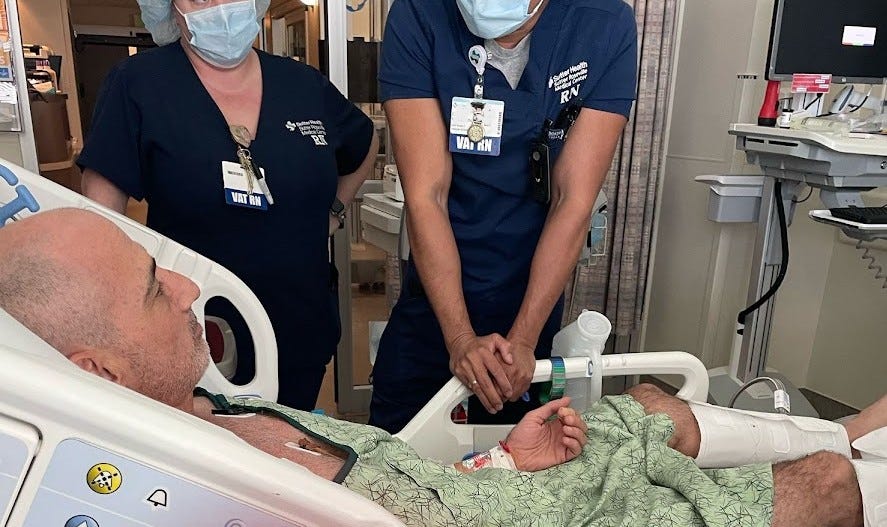
Picture this: You're lying on a hospital bed, literally dying, while a medical student learns how to perform a procedure.
First, a man and woman arrived to perform the procedure. He was Filipino, roughly my height (meaning, short), in his 40s, displaying the confident movements of someone who had placed hundreds of these lines before. She was also short, keeping both of them out of my line of sight for much of the procedure, and it was clearly her first time. She seemed overwhelmed from the moment they entered the room.
'Watch how I approach the patient,' he said from the doorway. 'You always want to stand here, introduce yourself, explain what you're doing before you do it.'
This continued throughout the procedure, as he patiently explained the reasoning behind every action in exhaustive detail, where to place the equipment, how to open each sterile package, how to put on gloves. Everything he did came with a detailed explanation followed by a demonstration and then her attempt to follow along. She was trying but visibly struggling with the information overload.
'It's okay,' he reassured her. 'It will take a few more procedures before you'll be ready to do one alone.'
Inside, I was screaming. It felt like being stuck in terrible traffic when you're already late for the most important meeting of your life. Shouldn't they be rushing? I'm literally dying here! Every few seconds, I looked back at the clock hanging directly in my field of vision. Its hands were barely moving, as if time itself was playing some cruel joke. If we had been in traffic, I would have been the person punching the steering wheel and screaming, except it was all happening in my head.
I wanted to yell at them to 'hurry up already!' and 'train on someone else!' But talking remained difficult. And what could I say that would actually help? Would they move any faster if I spoke up? Or would I just make things worse?
Beneath my frustration ran a deeper current of fear. I had no viable choice except to surrender complete control and trust these strangers with my life, something I'd spent forty-nine years avoiding whenever possible. It felt like I aged two years during those twenty minutes." (Beyond 100%, my upcoming book)
That moment shattered everything I thought I knew about strength.
The Day My Control Disappeared
For forty-nine years, I'd built my entire identity around being a person in control. Turning from "a boy" to "a man", seven years as a military officer followed by a career as a technology executive. Always the one with the plan. The one who could handle whatever life threw at me, and it did. The rock everyone leaned on. The problem-solver. Always in the driver’s seat. Control wasn't just what I did, it was who I was.
And then life stripped it all away in a single morning.
"Beeping machines counted out the seconds of my new reality. I was fighting to heal a vessel in my brain, while facing the collapse of everything that used to define me, independence, capability, control. My entire world had been upended in an instant. The tears that had broken through decades of restraint were an acknowledgment, a surrender. The necessary first step toward whatever came next." (Beyond 100%)
The First Surrender: Trusting Others
The first type of surrender I had to learn was external, giving away trust to other people. For someone like me, this felt like psychological death.
I had to trust complete strangers to keep me alive during that medical procedure. I had to let them move my body like cargo:
"I learned I was lying on something resembling a fishing net that could connect to a ceiling lift. When needed, they would lower an arm from the ceiling, connect all corners of the net, and use a remote to lift me up. Like a fish in a net, I wiggled in the air, squished and dangling as they transferred me from my bed to the scanner bed before lowering me down." (Beyond 100%)
The hardest part was asking for help.
"I'd never enjoyed asking for help or needing assistance. Honestly, I had never understood how some people could readily ask others to invest time and effort on their behalf. I viewed them as selfish, self-centered, and even weak. Asking for help had been my last resort, and even then, I carefully considered whom to ask. Throughout my life, this dominant, competitive mentality had earned me nicknames like ‘Lone Cowboy,’ ‘Napoleon,’ and ‘the Captain.’ "(Beyond 100%)
The Second Surrender: Accepting Reality
But there was a second type of surrender coming, one that would prove even more difficult: surrendering to the reality of what had happened to me.
For days, I'd been focused on the immediate crisis, medical procedures, basic survival. I could engage with the mechanics of recovery without fully confronting what it all meant.
Then came the breakdown that changed everything.
"Time dissolved into a meaningless blur. In between these events, I simply lay there, staring at my lifeless right hand with a mixture of desperation and rage. My fingers mocked me with their presence. I could feel them when touched, could visualize every movement in my mind, but they remained stubbornly still, as if they belonged to someone else entirely. It was like being trapped beneath an invisible lead blanket, able to feel but powerless to move.
I knew this feeling. Almost 20 years ago, I'd been in an accident that left casts on both my legs and arms. But the dread of being restrained against your will is instinctive, a primal fear of claustrophobia that almost anyone can relate to. Panic flashes through your mind when you realize you can't move, like being trapped in a collapsed cave with nowhere to go. I knew nothing would help except time, but that knowledge offered no comfort while being completely at the mercy of circumstances beyond my control, watching precious minutes tick away.
The medical staff moved around me with practiced efficiency, offering well-meaning suggestions. 'Let's adjust your pillows,' they'd say. 'Should we raise the head of your bed?' But their help only underscored my helplessness, each failed attempt at comfort fed into the growing storm of frustration.
The movements I could make became increasingly aggressive, each shift more forceful than the last. I tried every position I could manage, but nothing helped. The frustration built until something inside me finally snapped. A primal sound erupted from deep in my chest, 'ARRRR!', and my body seized in what doctors would later describe as a spasm. Every muscle clenched, my legs and arms stretched uncontrollably taut.
Then it happened again, this time more intense and with my legs shaking. All the pent-up tension had exploded within me. I wanted to scream at the top of my lungs, to trash the room, to smash every beeping machine and slam the door as I ran away from this nightmare. But I couldn't even do that much, I was trapped in a body that wouldn't obey my commands.
My wife later told me it was the first time she had seen real fear in my eyes. She was right. I was terrified. In that moment, the reality of such complete lack of control over my own body, my life, and everything that came with it finally sank in with a crushing weight." (Beyond 100%)
This was the moment everything became real. Not the medical explanations or the brain scans, but this raw confrontation with my new reality. I was no longer the person I'd been just days before.
The Deepest Surrender
"But then, my grandmother's words came back to me. I could hear her saying, 'The mind must stay strong,' and I drew in a deep, shuddering breath. I held the air in for a few seconds, exhaled loudly with a sigh, then did it again.
Something shifted inside me. I needed to give in without giving up. I had to accept what was happening. Accept that my body and brain were different now. I pushed it aside the added thought: And it will probably never be the same.
That was tomorrow's battle. For now, it was enough to acknowledge that this wasn't a nightmare I would wake from. This was my new reality." (Beyond 100%)
Here's the truth that took me a while to understand: there are moments in life when the only way forward is to stop fighting what is.
"Surrendering doesn't mean giving up, in fact, it's the opposite of quitting. It's the first real act of courage. Surrender means letting go of the fight against reality, against what is. Stop trying to force your will, your wishes, on things that are out of your control. Only then can you redirect your energy toward healing." (Beyond 100%)
The hardest part wasn't the physical limitations or even the uncertainty about recovery. It was the ego death. Watching the person I thought I was dissolve completely. The competent executive, the invincible father, the dependable husband, the oldest son, that person was gone, together with his plans and dreams; all went through a reset. "Reboot started."
I had to surrender to not knowing who would take his place.
"After that episode, I knew with certainty that I would recover to some degree. I'd heal enough to do everything I'd done before, perhaps with modifications. But even those could add character, from where I sat, walking with a cane seemed rather distinguished, even sexy. The path forward would be challenging, but I had a clearer sense of purpose, and a new environment that was optimized for my recovery." (Beyond 100%)
What Surrender Taught Me
Both types of surrender, trusting others and accepting reality, reminded me of something I once learned but forgot a long time ago: sometimes letting go is the most powerful thing you can do.
When I stopped trying to control the medical procedures, I could focus on healing. When I stopped pretending I didn't need help, people could actually help me. When I stopped fighting my new limitations, I started discovering new strengths.
Sometimes the best thing to do is stop doing. Stop resisting, stop rejecting, and just let go. Not fight the current, but float and let it carry you. The destination is unknown, but that’s a tomorrow problem. Surrender to it all, let go, you'll survive!
The person who emerged from that surrender wasn't the same person who collapsed on my office floor. He was someone I couldn't have accessed while gripping control so tightly.
Your Turn
I know your story isn't mine. Maybe no one hooked you up to machines or lifted you with ceiling nets. But something happened, didn't it? Something that split your life into "before" and "after." Whatever it is, it changed everything in ways you're still discovering. Life-altering moments don’t ask permission or wait for convenient timing. They just happened, leaving us standing in the wreckage of what we thought was solid ground.
Right now, you might still be in the fighting phase. Still trying to force things back to how they were. Still convinced that if you just push hard enough, control tight enough, you can somehow undo what's been done.
I get it. I tried that too.
But here's what I learned lying in that hospital bed, raging against my unmoving hand: the first step toward any real healing isn't fighting harder, it's finally stopping the fight. It's that moment when you take a deep breath and whisper, "Okay. This happened. This is real."
That's surrender. Not giving up, but giving in to what is, so you can start working with reality instead of against it.
Practical Tips and Tools
These aren't magic bullets; they're tools that worked for me when surrender felt impossible. Start with whichever one feels most doable today. I encourage you to come with an open mind, a nothing-to-lose attitude, if anything, try the 1% core practice. Let me know what worked.
The Reality Check: Are you still fighting to change what happened? It’s hard and maybe it will take some time, but when you’re ready, one day, pause and say out loud: "This _____ is real. This happened." Call out what happened, give it a name. For me, it was ”I had a stroke! It is real.” It sounds simple, but naming reality stops the mental spinning. The first step in solving any problem is admitting there is a problem, so call it out loud. When you are ready.
The Mirror Question: If you're like me, it's much easier to give help than to accept it. So ask yourself, what help would you offer your best friend if they were in your exact situation? That's what you need. Now, what would you tell them if they said, "No, I don't need help"? This question helped me realize that my ego was what was holding me back from making smart decisions.
The Language Shift: What would happen if you stopped apologizing for needing support and just said "thank you" instead? I noticed that when I started saying that, I felt like I was gaining some control, and it gave me confidence in the small change that happened in me.
Core Practice - The 1% Surrender:
Here's the honest truth: I failed many times at all of the advice I'm sharing with you. It took me a long time to accept help, or even accept the fact that I'd had a stroke. But gradually, I released the grip, and in the end, it all adds up! So give yourself a break. You don't have to do it all today. Pick one tip. Take one small step to release, to surrender. 1% micro steps each day. Small wins accumulate. It all adds up.
When to Use These: You'll know. Usually, it's when you're exhausted from fighting, or when you catch yourself instinctively saying "no thank you, I don’t need help" and deep down regretting it.
If you're in your own surrender moment right now, I see you. It's hard. It's scary. And you don't have to figure it out alone. Sometimes you need to hit rock bottom to start moving up, to start healing. You're not alone in this, and your surrender doesn't have to be perfect, it just has to be real.
About the author: Nir Peled is the author of Beyond 100%, coming soon. Join the early reader list to get the first chapters.
Nir, this is impressive writing. It is not only what you are saying but also how you express it. Your writing is in the vein of the stoic, Marcus Aurelius, whose words written centuries ago encouraged readers to make the accommodations to reality.
What he fails to shine the light upon is the laborious gearing needed for one to come to the truth of one’s heretofore unimagined state that now defines him. By elaborating your difficult yet ultimately successful struggle to change those characteristics that once made you you in order to get to the point of acceptance, you have made a contribution to my appreciation of stoicism.
Amor Fati is the ability to love your fate, whatever it is.
Praying for your continued strength.
When you reboot, you’re not the same being as you were before it. It’s like rereading a book over and over again. If the book is good, you’ll find things you missed with the first read through. It’s the same with us, it’s the same with me. I can see myself BC (before cancer), and AC (after cancer). There are things that I won’t put any energy into cause I don’t want to lose my energy to that action. You make choices and you grow pinch your butt off of a flower and everything below it will go stronger. Thank you for sharing your story, Nir.