

The Hidden Marathon
I survived. Now what.

It was a quiet morning, months into my stroke recovery, and I was standing alone in my living room, looking at a stack of printouts my therapist had left me.
The same exercises I had been doing for weeks. Nothing new. Nothing dramatic. Just a piece of paper telling me what today would look like. And tomorrow. And probably the day after.
There were no sirens in the scene. No doctors. No machines. Just me and our new kitten, a piece of paper, and a quiet feeling in my chest that I have since learned to call dread.
This is what recovery looks like most days. Most days are like this.
May is National Stroke Awareness Month. Across the country, every health organization is teaching the same acronym right now. FAST or BE FAST. Face drooping. Arm weakness. Speech difficulty. Balance and Eyes. Time to call 911.
The acronym saves lives. It saved mine.
The ambulance arrived eight minutes after my wife called 911. A few minutes later we reached the ER. It was ready for me. A team of total strangers, already in motion. Each one with a job. Each one with a place. Hands. Voices. Wires. Wheels. Numbers called out. Lines hooked. Bed turned. Scans. Fluids. Monitors. Heads popping in and out of my narrow view. Talking to each other. Talking to me. Asking me questions I could not answer.
I felt like a Formula 1 pit stop or like watching a movie at 2x speed. Except I was the main character in the movie. I was the car, and I do not recall entering the race.
A race against the clock. There is one word at the finish line, and that word is alive.
A few hours or days later, when everything calmed down, the doctors told me my life was saved. Most of what they explained went over my head, but the one thing that stuck with me was the timeline. What I heard was the start of a new race. This time it was more like a long-distance race. A marathon.
The first three months would be the most important and where I would see the most progress. After that, up to about eighteen months, progress would gradually slow and my recovery would reach a plateau. How close to who I was before, they were not sure. That was the time window.
I had spent seven years in an elite IDF unit. I had spent two decades in Silicon Valley. I heard “timeline” and “window” the way I had always heard them. As coordinates. As an X on a map. As a goal to hit and a clock to beat.
In one of my more stupid, arrogant, and naive moments, I told myself I would break every recovery record they had ever seen.
I knew this was not a sprint course. I could not brute force my will. The marathon was nothing like the sprint that had just saved my life.

The marathon I had been entered into was not the one people sign up for.
The course is hidden. The next step is uncertain. Even the finish line is unclear. Actually, there is no finish line. In this race I am the only runner. Most of the road is empty, with little to no crowd. I had no training. I was not looking forward to it.
In this marathon, I do not always know who I am anymore. I take a step into the dim, listen for the ground, and take another one. Some days I celebrate small victories. Other days, it feels like I am running backward, or in circles. Frustration, anger, and sadness, all making me want to quit. Like any marathon runner will tell you, it is a mental challenge more than a physical one. Emotions can be deceiving (I wrote about that in When Your Feelings Lie About Your Progress).
The rule I had to invent so I could keep running despite the odds, because of all the uncertainties, is the simplest one I have. I call it the Marathon Mindset.
The main ingredient in recovery from a stroke or any other life-altering event is time. Not willpower. Time. Consistency over years, not effort over weeks. The brain rewires itself slowly. The body rebuilds slowly. The spirit grows back slowly.
I needed to make time my friend, not the enemy I was racing against.
The Marathon Rule is a mindset: stop trying to win this. The road is long, and time does the work.
This is not the rule I would have chosen. My instinct, what worked for me before, was the line from a cult movie, Operation Savta: “Start as fast as you can and constantly accelerate.”
I am still learning it. Some days I push too hard and pay for it in the days after. Some days I lose my patience entirely, and it does not help me or anyone around me. Then I come back to the rule. The marathon does not care about my mood. It only counts steps.
I am still trying to let go of the man I used to be. The rule does not work if you keep chasing him (I wrote about that in When Surrender Became My Strength). You cannot keep running if you keep dragging the old version of yourself behind you.
Some steps of this marathon look like physical therapy. Some look like ten minutes of meditation in the morning. Some look like making coffee with one hand. Some look like getting out of bed at all.
Today’s step looks like a book.
Beyond 100%: Rebuilding Life After It Breaks came out last week. I wrote it across two years of recovery, not after it. It is a Body-Mind-Spirit framework for anyone walking through their own forced reinvention, whatever broke their old life. I wrote it because the road I had been put on was hidden, and I thought maybe a map would help the next person.
This article is not the launch announcement for the book. I want to say that plainly. The launch post is still in front of me. I am working on it. It turns out that publishing a book is its own kind of step, and somehow as hard as writing it. Maybe harder. Being seen is its own work. Showing up to be seen is its own work. I am still learning how to take this one.
So this is not the announcement. This is today’s step. The announcement is the next one, and I am walking toward it.
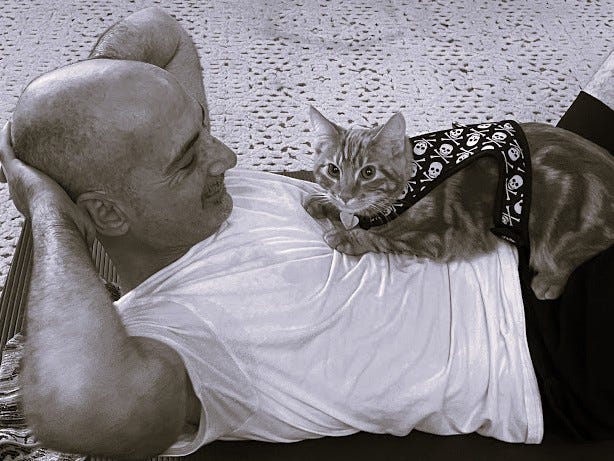
The marathon is still hidden. The next step is still uncertain. Nearly two years in, I do not know where the course ends, or whether it ends at all.
But the runner has changed. And maybe that was the point all along.
If you are running your own hidden marathon, whatever crashed your old life into this new one, the rule is the same. One step. Then the next one. Then the next one. That is the whole technique.
About the author: Nir Peled is a seven-time survivor, certified yoga instructor, and meditation teacher. His new book, Beyond 100%: Rebuilding Life After It Breaks, offers a Body-Mind-Spirit framework for anyone navigating forced reinvention after a life-shattering event. Learn more at nir-peled.com.